


General Surgery and Dental Care
Before any procedure, we will see you and your pet for a consultation to determine the necessary care together.
We understand that a procedure is always a source of great stress for you and your companion, which is why, regardless of the situation, urgent or not, our team is here to answer your questions.
For procedures, we use injectable and inhalant anesthesia to minimize risks, maximize recovery, and make the procedure as least traumatic as possible.

Surgery
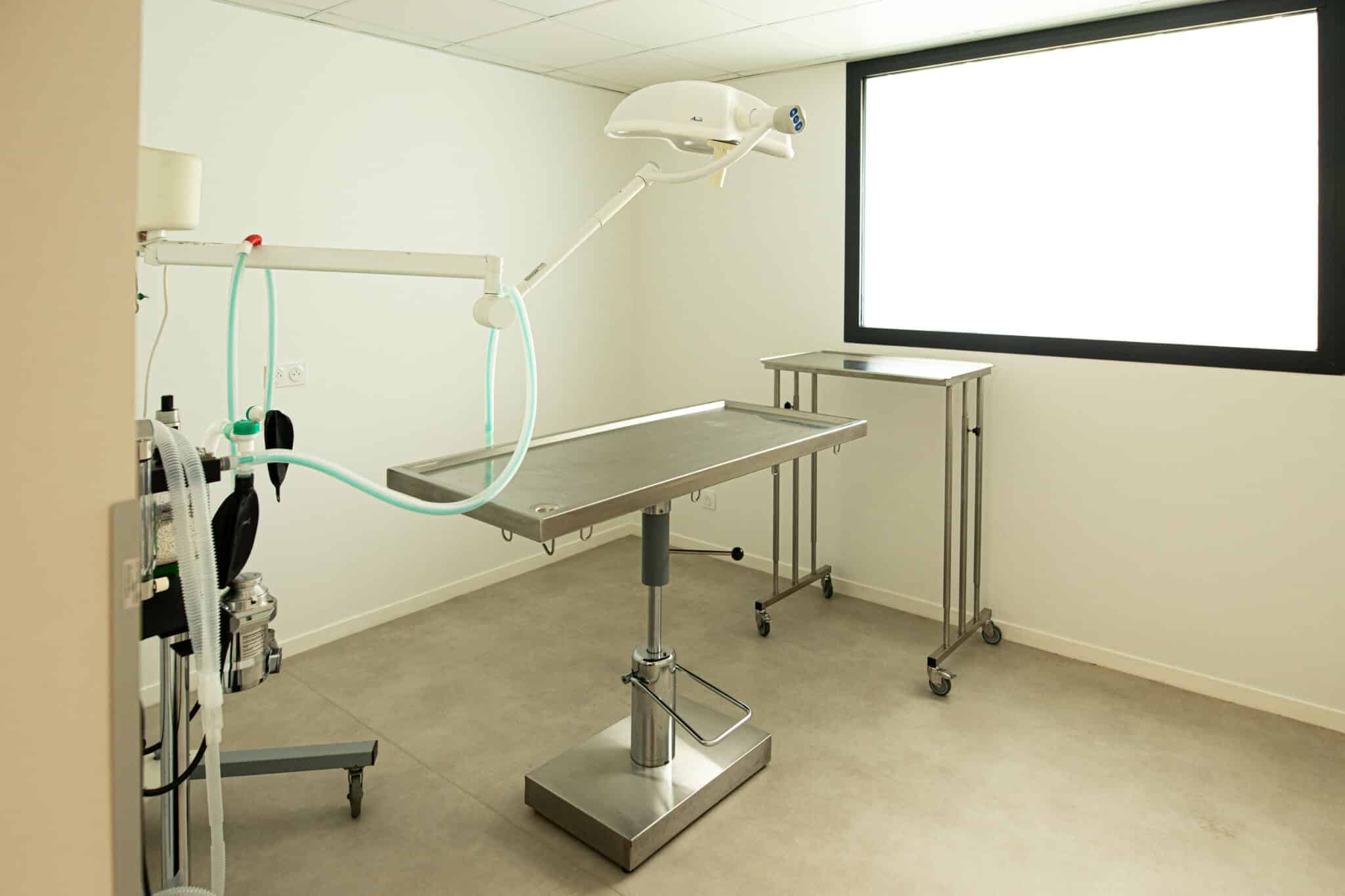
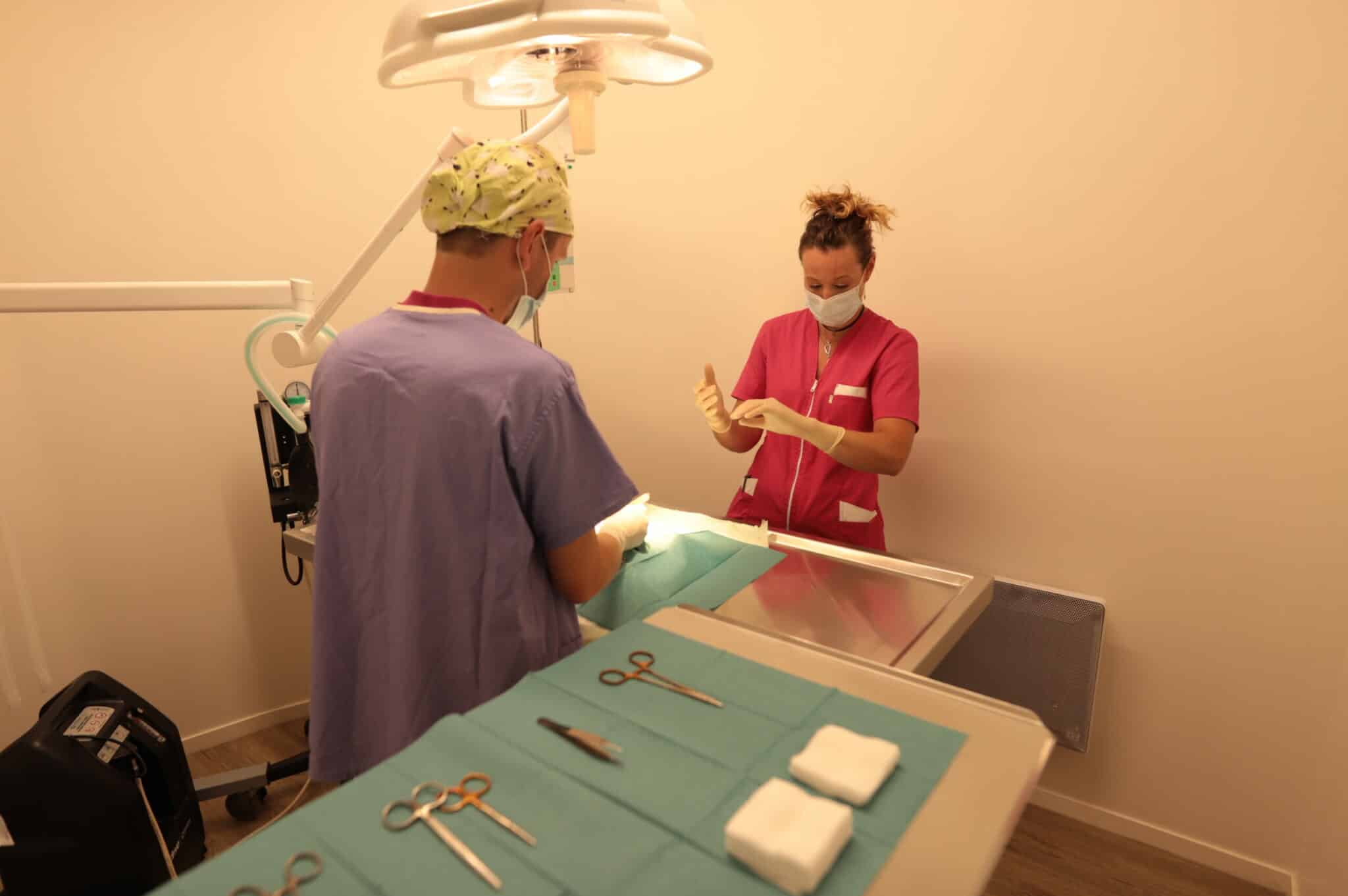
Whether for scheduled or emergency surgeries, our facility is equipped with state-of-the-art equipment. Operating room with inhalant anesthesia, capnograph, electric scalpel…
Whether for elective surgery, soft tissue surgeries, certain orthopedic surgeries, or some ophthalmic surgeries, we can perform the vast majority of procedures within our facility. Otherwise, we work closely with all specialists in the area, allowing us to advise you best.

Spaying/Neutering
Spaying/neutering is an elective surgery. This term includes castration for males and ovariectomy for females. It involves removing the testicles in males and the ovaries in females.
Spaying/neutering can be performed from 6 months of age. It is an outpatient surgery, meaning it is performed within a day and does not require hospitalization.
Spaying/neutering has many benefits, such as the prevention of certain cancers (mammary cancer in females, for example), or other diseases (prostatic hyperplasia in males…), or even certain behavioral disorders (aggression, roaming…).
Recovery is short, and healing takes 12 days.
For any questions, please do not hesitate to contact us; we will be happy to answer them.

Dental Care
Just like us, our four-legged companions can develop tartar. Some breeds are more predisposed due to their oral pH (mainly small breeds). Tartar infiltrates between the tooth and the gum, initially causing gingivitis with some bleeding. If left untreated, periodontitis can develop, potentially leading to complete tooth loss and/or dental abscess.
In cats, the mouth can be the site of certain viruses like calicivirus, causing tongue ulcerations and gum inflammation.
Other pathologies such as benign tumors (e.g., epulis in boxers…) or more aggressive ones (mainly carcinoma and melanoma…) can develop in your pet’s mouth.
Fortunately, solutions exist, such as scaling, dental care, etc.
We can advise you on the best solution and perform all necessary care within our facility.
Answers to your questions!
Your pet must fast for at least 12 hours before any anesthesia.
Our clinic has the same resources as those found in human medicine. We administer premedication by injection, followed by inhalant anesthesia once your animal is intubated (exactly as in human medicine). This offers the advantage of significantly reducing risks, benefiting from a smoother recovery and a faster return to form for your pet after the procedure.
Generally, you can pick up your pet on the evening of the procedure. If needed or for major procedures, we can keep your dog, cat, or other animal longer. Our clinic has a hospitalization service. Your companion is in good hands!
Yes and no. In both cases, it aims to prevent your pet from reproducing.
In males, castration involves removing the testicles, while in females, ovariectomy involves removing the ovaries. In some cases, we may also need to remove the female’s uterus (for example, in case of infection or tumor…).
After any procedure, one of our assistants will meet with you to provide all post-surgical instructions. You will be shown how to administer medication if needed (liquid or tablets), as well as some tips to help you. A handout with all these instructions will be given to you.
Above all, do not hesitate to contact us if you have any questions or concerns.
The mouth is not the easiest area to observe in your pet daily.
In case of strong odor, discomfort, pain, or bleeding, it is important to contact us, as these are often signs of an oral problem.
You can also adopt simple dental hygiene practices for your pet to avoid complications (teeth cleaning, dietary supplements, chew sticks, etc.)
Contrary to popular belief, licking will not disinfect the wound! On the contrary, it will cause inflammation that can be detrimental to healing. To prevent this, contact us; we will provide you with a means to avoid it (Elizabethan collar, neck brace, pet shirt…).